
Omnicom Media APAC releases 2026 trends report
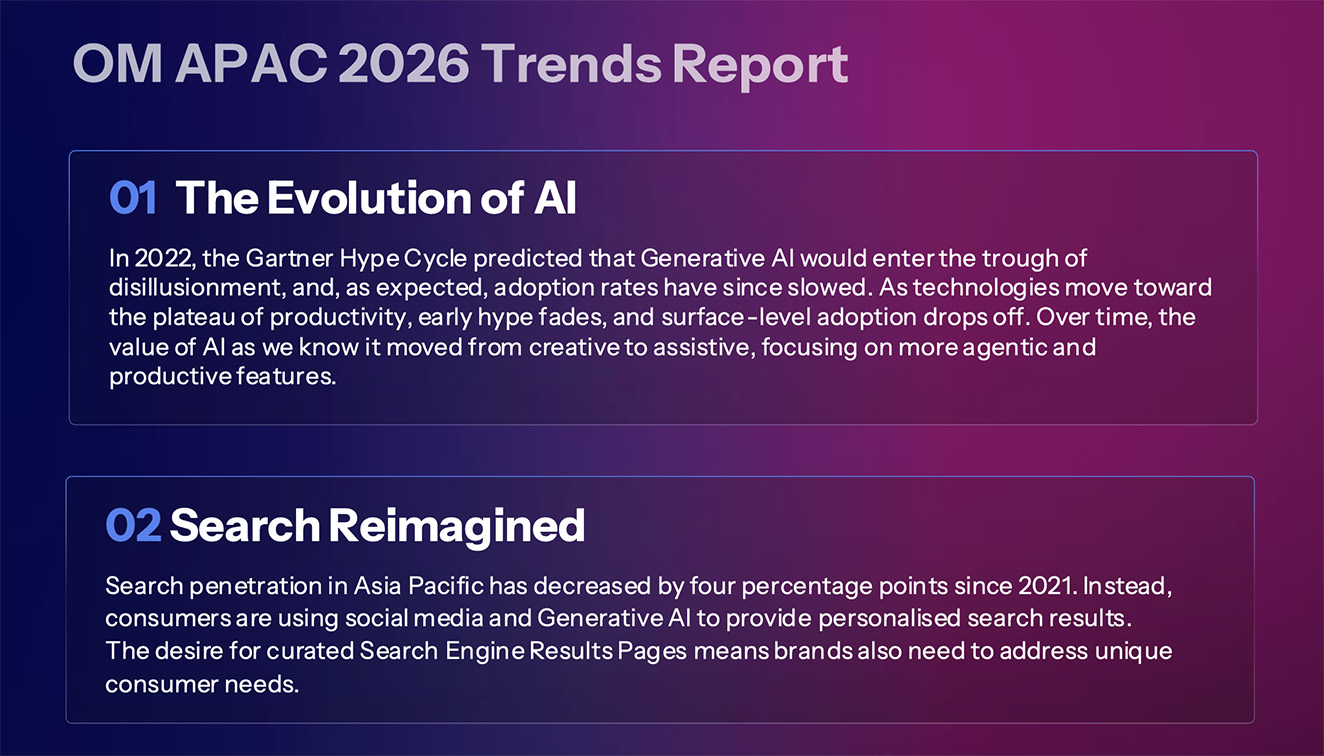
Omnicom Media Asia Pacific (OM APAC) has unveiled its 2026 Trends Report on the back of the recent Consumer Electronics Show (CES) in Las Vegas, exploring the key themes and trends across media, technology, and consumer behaviour shaping the new year.
Inspired by recurring themes observed over the past year and at CES 2026, including Agentic AI, the new realities of brand influence, co-creating with consumers, and the creator economy, the report shines an APAC spotlight on these developments to identify why they matter to brands and consumers. OM APAC conducted analysis for the trends report using regional and local data from third-party tools, including GWI, and through consultations with local markets.
Nina Fedorczuk, Chief Enablement Officer, OM APAC, said, “2026 is going to be an incredibly exciting year for us, as we unlock new opportunities for clients by leveraging consumer, industry-specific, and technology-driven trends. As more advanced technologies emerge, we expect they will further enrich consumers’ lives in never-before-seen ways and enable new approaches to how brands interact with consumers. AI will remain a key focus for our industry, especially as autonomous AI continues to evolve and impact our professional and personal lives. At Omnicom Media, we can’t wait to further deconstruct these trends for our clients, the categories and markets they operate in, as well as the consumers they seek to engage.”
For brands looking to stay ahead of the curve in 2026, here are the key themes and trends to watch.
1. Everyday life is effortlessly enabled by intelligent tech
The world is moving towards technology that anticipates consumer needs or minimises manual consumer intervention, primarily enabled by the growing ubiquity of artificial intelligence capabilities and the consolidation of identities across platforms and modalities.
This evolution was reflected at CES 2026, where agentic AI and AI-powered technologies remained key highlights. Brands showcased health tech, smart home solutions, and autonomous vehicles that leverage AI to deliver highly personalised services, underscoring how anticipatory, intelligence-led systems are becoming central to everyday consumer experiences.
• Trend 1: Artificial intelligence is becoming more intelligent. Since 2023, the use of AI has moved from creative to largely assistive tasks, both for personal and professional tasks: 64% of key APAC markets are already using AI for productivity, and in the workspace, seven out of 10 organisations are in the process of deploying, or have already deployed, AI agents for their respective workflows.
• Trend 2: Technology that anticipates and reshapes discovery. Even traditional search engines like Google have begun incorporating AI overviews into their Search Engine Result Pages, resulting in 1.6x more closed browsing sessions, as users already receive all necessary information without clicking through multiple landing pages.
• Trend 3: Intelligence that understands consumers better than they do. AI capabilities are also facilitating the development of Ambient Intelligence, which relies on passive input from smart sensors to sense, adapt, and respond to consumer needs. This new seamless experience will be useful in applications where a consumer may not be able to articulate or understand, their needs, such as in healthcare where intelligence may be able to detect symptoms across various sensors, and triangulate potential diagnoses.
• Trend 4: The convergence of physical and digital. Various member countries in the ASEAN are developing digital identity wallets – such as Singapore’s SingPass – designed to serve as digitised national IDs. This advances the region’s progress toward the ASEAN Digital Masterplan for cross-border IDs, easing travel and transactions among citizens of member countries. Alongside new regulations requiring social platforms to verify user identities, such as Malaysia’s Online Safety Act, this signals a new World Wide Web in which personal and digital identities are the same.
Brands and consumers are advised to prepare for a world where technology is seamlessly integrated into consumers’ daily lives – whether at work, in brick-and-mortar stores, in our homes, or even in immigration lanes.
For brands, this means structuring content for large language model ingestion and adopting a more robust data architecture, managed through clean rooms, for more accurate targeting and a diversified channel mix. For consumers, it means becoming more comfortable with granting technology greater autonomy – within reason – to make decisions on their behalf, all to improve lives.
2. Give consumers a seat at your table, and they’ll drive it forward
CES has highlighted the new realities of brand influence from initial consideration to purchase. In the age of social commerce, smart glasses, spatial computing, and AI-driven discovery, brands must consistently and authentically show up, developing spaces where consumers can engage, respond, and co-create.
Technology has facilitated a two-way relationship between brands and their consumers – one in which consumers can freely let brands, and even other buyers, know what they think about products, services, or even advertisements.
• Trend 5: Social media facilitates conversations between brands, creators, and consumers. Social media is now the top association for livestreams, overtaking tentpole events, with four in five viewers associating live streaming with daily chats. This was enabled by social media, gaming, and e-commerce platforms adding streaming capabilities, in turn allowing viewers to interact with live content more easily and enabling instant feedback (such as conversions and gift-giving).
• Trend 6: Second-screening adds another, more intimate screen to reach viewers. Four in five livestream viewers in Asia Pacific use their smartphones for second-screening, following CTAs such as QR codes or clickable links to learn more about a product or participate in online discourse surrounding a tentpole event, thereby expanding the reach of the live content.
• Trend 7: E-commerce levels the playing field between David and Goliath. The proliferation of e-commerce has levelled the playing field between small and large brands, in turn giving consumers more space to be more selective in their brand choices and to share their experiences with other shoppers. As a result, trust, rather than convenience, becomes the key determinant of how consumers shop, with 61% believing that most big companies look for ways to take advantage of consumers.
One in four Asia Pacific consumers is more likely to promote brands that they feel they have taken part in. Interactive capabilities such as livestreaming, connected TV, polls, or physical activations allow consumers to make their voices heard. This encourages consumers to engage more with brands and provides a layer of consumer insight, which can be used for future campaigns.
3. Consumer expectations are higher than ever, but so are the opportunities to meet them
In an era of fragmented attention and rapidly shifting cultural moments, brands must return to fundamentals by focusing on what consumers value most and meeting them where they already are. Creators and community-led engagement, which are still focal points at CES, remain key pillars for helping brands build relevance and trust.
Social media, in particular, has enabled niche communities to emerge. While these communities were previously limited to message boards, it’s now easy to find groups or even content creators that cater to more specific interests. As consumer expectations continue to rise for authenticity, personal relevance, and two-way engagement, brands need to rethink how they harness technology, creativity, and media innovation to form deeper, more meaningful connections with their audiences.
• Trend 8: Create irreplaceable experiences and tap into ‘little joys’. Consumers are now also seeking out enrichment from their products. For example, experienced luxury buyers have shifted to luxury travel and wellness experiences, viewing them as “investments” in their long-term well-being. Female athletes also inspire not just girls but also two in five boys. And even affordable luxuries, like blind box toys, become small but frequent reprieves in fraught economic times, thanks to interactive features such as claw machines or unboxing mechanisms. These factors help increase a product’s perceived value, especially when the experience is shared with others.
• Trend 9: Understand what motivates consumers. For every big brand, there are tens or hundreds of smaller brands selling the same thing, but more of it. In the luxury space in Asia-Pacific, consumers are increasingly seeking out products from the region for their affordability, high quality, and most importantly, a bespoke understanding of local consumer needs.
• Trend 10: Treat your consumers as people, not numbers. For sports fans, female athletes aren’t just influencers – they are also role models. In fact, two in five boys consider professional women’s athletes inspirational. This ability to connect with people on a personal level also positively impacts their influence as brand ambassadors: female athletes are 14% more trustworthy as product endorsers, and consequently, their fans are 2.8x more likely to purchase a product endorsed by them.
Consumers believe that they are no longer just paying for the product or the service, but the lifestyle(s) these enable and the aspirations they stand for: whether it’s a small blind box toy that allows them to indulge despite tightening of purses; a female athlete that is a powerful role model for their children; or even a luxury travel experience that will shape who they are in the future. To stay competitive, brands must clearly articulate the non-monetary value they offer and consistently communicate it across every consumer touchpoint.