#NepalCalling: When a Tourism Campaign Became an Act of National Solidarity
By Kanishka Dasgupta, Creative & Communication Strategist, India & Nepal.
There are moments when communication becomes more than communication.
There are moments when an industry, a profession, or an idea has to decide whether it will remain an observer of events or become an active participant in shaping what happens next.
For Nepal, the devastating flash floods of 2026 created precisely such a moment for us at Storm Communications Nepal. We came forward for the country.
The immediate human tragedy was overwhelming. Lives were lost, families were displaced, infrastructure was destroyed, communities were cut off, and the economic consequences began to emerge alongside the humanitarian crisis. Under such circumstances, speaking about tourism can initially appear insensitive, even inappropriate. When a country is grieving, should it really be asking the world to visit?
That was the question at the heart of #NepalCalling.
And it was not an easy question.
The Visible Disaster and the Invisible One
The scale of the physical devastation was immense.
According to the figures available at the time, 1,294 bodies had been recovered, while 5,053 people remained out of contact. 13,095 people had been rescued, and 5,663 injured people were receiving treatment. Another 4,627 people were staying in temporary holding or relief centres.
In total, 32,963 people were directly affected.
The destruction extended far beyond individual lives. 7,570 private houses were damaged, including 2,418 houses that were completely destroyed. Approximately 55 kilometres of roads were completely destroyed, while 37 motorable bridges were damaged or destroyed.
The preliminary government estimate placed the economic damage at NPR 387.54 billion, equivalent to approximately US$2.56 billion.
These numbers describe physical destruction, but they do not fully describe the psychological consequences of a disaster.
Disasters also change perception. And this created a second, less visible risk for Nepal.
What if the physical disaster was geographically limited, but the perception of the disaster became national?
That was the concern.
The directly mapped flood, mud, and rock-flow footprint was approximately 0.02% of Nepal’s total land area. Put differently, more than 99.98% of Nepal’s land area was outside this mapped physical flood footprint.
This statistic does not diminish the severity of what happened. It does not make the loss of life or destruction any less tragic.
It simply provides essential geographical context.
Nepal was experiencing a hugely devastating disaster. But Nepal, as a country, was not entirely a disaster zone.
That distinction became fundamental to the thinking behind #NepalCalling.
When Fear Begins to Affect Livelihoods
Tourism occupies a particularly important position in Nepal’s economy because its impact extends far beyond hotels and airlines. Tourism income stood at NPR 83.39 billion in fiscal year 2024 and NPR 87.37 billion in fiscal year 2025.
A traveller’s expenditure moves through an ecosystem of guides, porters, drivers, restaurants, hotels, airlines, handicraft producers, shopkeepers, travel agencies, and countless informal workers whose incomes depend, directly or indirectly, on visitors.
Consequently, when travellers cancel their plans, the economic impact does not stop with the cancellation of a hotel reservation.
It travels through the entire chain of livelihoods. And the timing made the situation even more serious.
September to November normally accounts for approximately 40% of Nepal’s annual international tourist arrivals, making this period the country’s critical tourism season.
The concern, therefore, was not simply about a temporary decline in visitor numbers. It was about what could happen if a perception of Nepal as an inaccessible or unsafe destination became embedded just as the peak tourism season was beginning.
There were already indications of such a reaction.
Some operators reported that approximately 20–30% of their peak-season bookings were cancelled within one weekof the disaster. Some Indian travel operators reported cancellations of 60–70% for late September and October trips.
The figures were early indicators rather than a complete economic assessment.
But they were enough to raise a difficult question:
Could the humanitarian disaster become an economic disaster because the world stopped coming to Nepal altogether?
Looking Beyond the Headlines
This was the point at which the idea for #NepalCalling began to take shape.
The campaign did not begin with the assumption that Nepal had to be portrayed as completely normal. That would have been neither credible nor respectful. Nepal had suffered. Lives had been lost. Communities had been devastated. Infrastructure had been destroyed.
The objective was not to deny that reality.
It was to prevent another reality from being created through misunderstanding.
We began examining the condition of Nepal’s major tourism destinations—the places that form a substantial part of the country’s international tourism proposition:
Kathmandu, Pokhara, Chitwan, Lumbini, Bardiya, Bandipur, Janakpur, Muktinath, the Annapurna region, and the Everest region.
Across these 10 major destinations being used for #NepalCalling, none had suffered direct flood damage according to the campaign’s mapping—0 out of 10, or 0% directly affected.
Again, this does not mean that Nepal had escaped the consequences of the disaster. It means something more precise:
The places that define much of Nepal’s tourism experience were not collectively wiped out by the disaster.
They remained destinations where travel could continue, subject to local conditions and normal safety considerations.
That distinction was important enough to communicate.
From Promotion to Participation
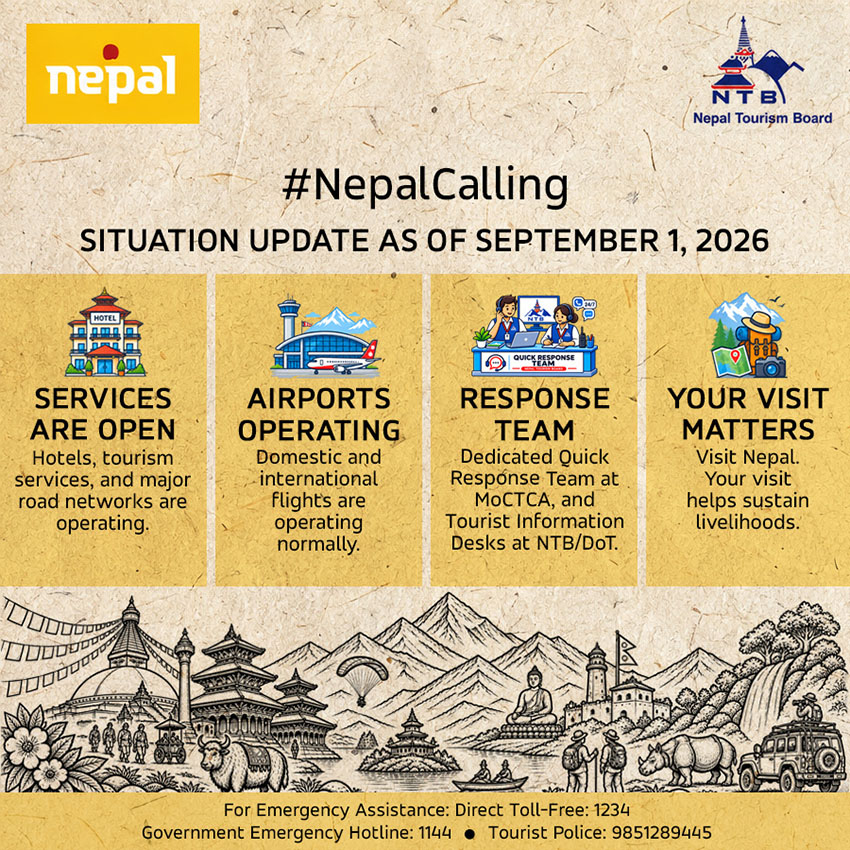
The idea was developed in close coordination with the Nepal Tourism Board for facts and figures, but its spirit was deliberately different from conventional tourism advertising.
There was no attempt to create an artificially perfect picture of Nepal. There were no claims that nothing had happened. There was no attempt to hide the pain.
Instead, the campaign attempted to hold two truths simultaneously:
Nepal has been devastated.
And:
Nepal is still open.
That is a much more difficult message to communicate than simply saying that everything is fine. Because everything was not fine.
The challenge was to communicate resilience without denying suffering.
And that is why the campaign did not rely solely on conventional advertising voices. Actors participated. Hoteliers participated. Students participated. Tourism professionals participated. Citizens participated. Travellers participated. Ordinary people participated.
Each person brought a different voice of their own, but the underlying message remained remarkably simple:
Do not cancel Nepal simply because Nepal has suffered a disaster. Remember #NepalCalling.
Why a Visit Can Become an Act of Solidarity
There is an important distinction between charity and economic participation.
A donation can provide immediate relief. It can support emergency response, food, shelter, medicine, and reconstruction.
Tourism operates differently. When a traveller visits Nepal, money moves through the economy repeatedly. A hotel employee earns a wage. A driver gets a passenger. A guide gets work. A restaurant serves a meal. A porter carries a load. A local business makes a sale.
A family receives income.
The economic value of that journey is distributed across a network of people.
This is why tourism can become one component of recovery.
Sometimes, therefore, continuing to travel can itself be an act of solidarity. Not because the traveller is rescuing Nepal, but because the traveller is participating in the economic life of a country trying to recover.
The Campaign That Did Not Behave Like a Campaign
Perhaps the most interesting aspect of #NepalCalling was not the creative execution. It was the way in which the idea evolved beyond the boundaries of a conventional campaign.
There was no single celebrity at its centre. There was no dependence on a large media budget. There was no rigid script that every participant had to follow. There were no carefully controlled statements designed to make every voice sound identical.
Instead, people spoke in their own words.
The campaign became less about advertising to people and more about enabling people to speak for Nepal.
That distinction matters. People are often more willing to believe another human being than an advertisement. When a citizen says that Nepal is still standing, it carries a different emotional weight from a tourism advertisement making the same claim. When a traveller says that Nepal remains worth visiting, it is not simply promotional messaging.
It is testimony.
And when hundreds of people begin repeating the same fundamental truth through their own voices, communication begins to resemble a social movement more than a conventional campaign.
What This Says About the Role of Advertising
The larger lesson of #NepalCalling extends beyond tourism.
Advertising is generally understood through the language of commerce: brands, consumers, sales, market share, awareness, and conversion.
But advertising is ultimately a discipline built around one fundamental human capability:
The ability to influence perception through ideas.
If that capability can be used to sell a product, it can also be used to correct a misunderstanding. If it can create desire, it can also create empathy. If it can build a brand, it can also build confidence.
And if it can persuade someone to buy something, perhaps it can also persuade someone not to abandon a country at the moment that country needs economic confidence most.
Sometimes, the most meaningful campaign is not the one that wins a consumer.
It is the one that gives people a reason to think—and a reason to care.
Beyond a Campaign
#NepalCalling began with uncertainty.
Was this the right moment? Would people misunderstand the intention? Would talking about tourism while people were suffering be perceived as insensitive?
Those questions were legitimate.
But another question was equally legitimate:
What happens if everyone waits for the perfect moment to speak?
By the time that moment arrives, the damage may already have moved from physical infrastructure into livelihoods, businesses, and confidence.
Nepal does not need the world to forget what happened. It needs the world to understand what happened accurately.
It needs the world to recognise the areas that were devastated, while also recognising the enormous parts of the country that remain open.
It needs relief. It needs reconstruction. It needs resilience.
And, as the tourism season begins, it needs travellers.
Not as saviours. Not as donors. But as participants in Nepal’s recovery. Because a journey can sometimes mean more than a journey. And thousands of visits can mean something much larger: the beginning of economic recovery.
That is ultimately what #NepalCalling is trying to say.
Not that Nepal has not suffered, but that Nepal is more than its suffering. Not that the disaster did not happen, but that the disaster does not define the entire country.
Not that the world should look away from Nepal’s pain, but that the world should not look away because of it.
This is why we believe #NepalCalling deserves to travel beyond Nepal’s borders.
Because the idea is ultimately bigger than any challenges. It is about what communication can do when it chooses to stand beside people rather than simply speak to them.
And, perhaps most importantly, it is about hope. And now, more than ever.
Nepal is calling.